

Walking on broken glass
Content Warning: There is a lot of societal context in this essay with the potential to yuck your yum. Do not let it.
Note: The Dear Writer letters will now be appearing weekly on Tuesdays instead of Sundays.
Dear Writer,
I have a confession; I find Regency romances wonderful and so, so satisfying.
I mean, on the surface… Regency is the shit, right? The dances and the dresses and the possibility of finding true love against odds which have been systematically stacked against such fantasies. Horses and carriages and beautiful music under candlelight, the stuff from which fairy tales are made, all alongside a society built by demons who actively want the fairy tale to fail. So many rules, all designed to a purpose you can’t really think about because the rules are made of these staggeringly beautiful, impossibly fragile blown-glass figurines that will break if you so much as breathe too hard. You must be careful how you step until all you can focus on are your own movements, and you kind of forget that if any of that glass should break, the shards will slice your life to ribbons in an instant.
So… you endure the endless pulling of the corset stays until they are so tight you can’t breathe, let alone actually think about why you must wear them in the first place.
You don’t think about the fact that the search for a husband is really about finding the best possible enforced servitude situation in which you will have to fuck your boss and bear his spawn. And you must be careful not to make your boss angry, because he can beat or kill you with zero real consequence. He’ll just go out and get a new model of… well… you. You must spend your time learning to dissemble, to dodge, to manipulate and create illusions under which you might be able to move, just a little, to get what you need, or escape… for a while… that which needs you, and then if anyone sees what you are doing, they will call you a witch and maybe burn you at a literal or figurative stake, depending upon the fashion of the day. But be sure to smile and be demure and not get fat, or someone might actually see you, and that is death.

You are not served by noticing all of this, including that the entire illusion is held up by an invisible—I’m sorry, I mean erased—servant class that, from one perspective, seems just delighted for the opportunity to even to witness such splendor. They have to seem that way, because if you are not pleased with them (sound familiar? probably not, don’t think about it) they could lose everything and be thrown into a world of poverty that is also made to tuck neatly inside shadows cast by the flickering candlelight shed by the mansions full of dancing lords and ladies.1
You don’t notice that the extreme power imbalance between men and women was set up to create this exact scenario, in which we are distracted from the dark underbelly of the era by a magnificent parade of elegant dresses and fairy tale balls and mesmerizing music and extremely specific dancing. You are so busy trying not to break the fragile blown-glass figurines around you that you hardly have time to think about anything else.
And that’s exactly how the whole thing was designed, like a delicious and artfully decorated cake with a top tier so painstakingly constructed and mouthwatering that you do not notice as you descend down through the lower tiers… you know, the bigger ones that make it possible for the tiniest tier to balance at the top and grab all the attention… that the cakes are increasingly contaminated with dirt and darkness and blood.
Until bit by bit, you discover you have eaten your way into hell.
And yet…
Regency romances, in which you just don’t think about all of the darkness that holds up the fantasy, are so popular for good reason. In these stories, the top tier of the cake has been sliced off and presented to readers in a way that preserves all of the fantasy, with so many rules and procedures and societal norms forcing our heroes to hold such unnatural postures that it’s a joy to see them break out of their impossible restrictions, run toward each other in the night, and just fuck each other hard up against a lamppost in the rain.
I get it.
I’ve been watching Bridgerton.

The Year of Writing Magically 2026 is officially open to registration! You can subscribe via Substack or the website for the whole year for $900, or via Substack monthly for the 10-months of the workshop at $90/month.
The Bridgerton of it all
When I was a kid, the longest you’d have to wait for a new season of a show to come out was generally May to September, during which you were running around outside anyway. Now, instead of the old annual television standard of 22 episodes with a four-month hiatus, you get about six to eight episodes, and at least a year—if not two to three—between. What this means for most shows is that I horde them over years like a dragon sleeping on its accumulation of gold. I watch the first season, and if I like it, I put it on a list and once it’s ALL done, years hence, I will sit down and have myself a glorious lost weekend.
Look for my Silo essay sometime in 2032.
Not so Bridgerton. When a new season drops, I watch it all immediately. Then I wait anywhere from 15 to 30 months for the next season to drop, in anticipation of which I spend the weeks prior to said drop re-watching all the previous seasons.
I know what Regency stories really are. I see the things the dancing and music and exquisite cakes baked with an expert hand by the skillful, and skillfully erased, underclass are designed to hide. I know that the reality of the era for women (and the men who didn’t like being forced into the role of the monster) is dark and horrific and as I write about this, I’m actually kind of talking myself into writing a series of Regency romances with that horror built in.
Hmmm. Let me set that aside to steep for a bit.
I, like many other readers, enjoy the fantasy that is contained in the top tier of that horror cake. It is so made for fiction. One of the big challenges in writing fiction is how to build the conflict; who is the protagonist, who is the antagonist, and why is the antagonist trying to stop the protagonist? Then there’s the romantic conflict, which needs to be a believable and understandable (and yet, ultimately surmountable) reason why our paramours can’t be together. If you write that well enough, you switch on the yearning tap, and yearning is everything in a romance.
In a modern world where people can mostly be with whoever they want, the romantic conflict often comes down to they’re so hot but they’re so annoying which is not satisfying.
But in the Regency world, where rules are everywhere and they’re ridiculous but everyone believes in them and follows them and there are dire consequences if you step even a little bit out of line and marriage is the only island in this sea of fragile glass where you might be able to breathe for a minute and if you can just be on that island with someone you actually love, and who actually loves you?
Then… you are saved.
And it’s all so, so good and satisfying if you just don’t think about who created the island, and who made the sea of fragile glass, and who benefits from you being too busy trying to survive to notice those things.
Don’t blame Jane.
This all started with Jane Austen, who wrote the first Regency romances, because she was living them. Granted, she was living them from just slightly outside of center. Her family wasn’t quite as wealthy as the others, her prospects not quite as promising. She wrote about the entirety of the cake… well, with the exception of the very deep levels in which the servant class lived… and there is an acknowledgement of the higher-layer darkness, even alongside the humor.
Her first novel was Sense and Sensibility, a story about a family of women who, when their father dies, loses everything because women can’t have money or own property… and are eventually saved by the love of men from the nobility.
Then, we get Pride and Prejudice, a story about a family of mostly women headed by an older male who will not, despite his apparent presumptions, live forever, and are a thematic prequel to Sense and Sensibility. When the family falls into ruin because of a younger sister who only sees the top tier of the cake, they are saved… by marriage with men of the nobility.
Emma is about a wealthy woman who doesn’t need to get married and is therefore at the height of possible privilege who eventually realizes that there are poor people in the world and she should be kind to them… therefore being saved (morally, if not financially) by the love of a man from the nobility.
Jane Austen, unlike most modern Regency writers, does include the first few tiers of the hell cake… just up until the one she lives in. I do not recall any servants in these stories being anything other than grateful for the fact that they work for good families… which is a shadow acknowledgement of the tiers of the hell cake in which servants who work for not-good families must reside, without actually exploring all that.
And you know what? That’s okay. Jane wrote about what she lived. The fantasy she engaged with was fucked up, but if you could find that man of nobility to save you from the broken glass and the hell cake… why wouldn’t you wish for that, if that fantasy was available to you? Don’t we all put our energies into pursuit of the dream job that pays well, provides decent health care, and doesn’t destroy our soul… even though so many people don’t get that, through no real fault of their own, and often suffer and die as a result?
The flavor of the tiered hell cake is different now, but it’s still a tiered hell cake.
Except now, ideally, none of us are forced to fuck our boss. Yaaaaay… progress?
Understand, I’m not judging you if you love or write Regency romances. The longer this essay goes, the more I am kind of jonesing to write that Regency romance-horror. So let me be clear; there is nothing wrong with the stories that delve just into the top-tier-cake fantasy of it all. If you want to have your (top tier of) cake and eat it, too, then do that. Life is hard. You are allowed to enjoy the fairy tales that are available to you. This is not a moral indictment, or a superiority screed. I am deeply enjoying Bridgerton, and I love me some Austen, for which I do not need to apologize lest I get cut by the broken blown-glass figurine fragments of our left-wing purity culture, which mostly come for those of us on the left, because we’re the ones who care.2
I’ve been sliced by them before. It’s survivable.
Here for all of it
I love the music, and the balls, and the dresses, and the societal restrictions, the fucking up against the lamppost… all of it. I am here for that top tier of cake with all of its restrictions and society as the antagonist. Yum yum. Feed me, Seymour.
But also… every now and again, right in the middle of all of this wonderful cake, there is a moment, not of blood and dirt and darkness, but rather, of clarity, that will suddenly pull me out of all of the nonsense and drop me on a patch of land that is full of greenery and vegetation and reality, and has just enough room for me.
I love that the most.
There is this moment toward the end of Pride and Prejudice when Mr. Darcy’s uptight aunt, Lady Catherine de Burgh, confronts Elizabeth about her relationship with Colin Firth.
I mean, Mr. Darcy.
Lady Catherine, as a personified representation of society (which I love, always do that, never let your antagonist just be society) tries to surround Elizabeth with a new set of blown-glass figurines, after all the old ones were broken when her sister Lydia smashed them all… and the family survived it.
Elizabeth now knows that the danger represented by those figurines is survivable. She is no longer cowed by the threats of something breaking that has already been broken. She sees the reality of the situation, and can’t be intimidated anymore.
“Obstinate, headstrong girl! I am ashamed of you! Is this your gratitude for my attentions to you last spring? Is nothing due to me on that score? … I have not been in the habit of brooking disappointment.”
“That will make your Ladyship’s situation at present more pitiable; but it will have no effect on me.”
I have often talked about my fascination with the disagreeable heroine. As a born people pleaser… someone determined never to upset anyone’s fragile, blown-glass figurines, even the ugly ones that desperately need a good smashing… the disagreeable heroine has been my fantasy catnip from jump. My first book, Time Off for Good Behavior, is a clear disagreeable heroine fantasy, and I had no idea the steam I was personally blowing off at the time I wrote it.
The disagreeable heroine is the opposite of me; she is a born figurine smasher. Someone who says what she thinks, regardless of whether it will upset anyone, even people who desperately deserve to be upset. Someone who values her own time, her own experience, her own autonomy. Someone who doesn’t care if someone… I shudder just to think of it… doesn’t like her.
It’s like sinking into a warm bath.
And the first taste of that warm bath that I ever got was the moment that Elizabeth Bennet breaks free from all the bullshit, and tells Lady Catherine de Burgh to kindly shove it.
In unrelated news… I got my first tattoo yesterday. It’s on my inner left arm, right below where my watch sits, where I will be guaranteed to see it every day.
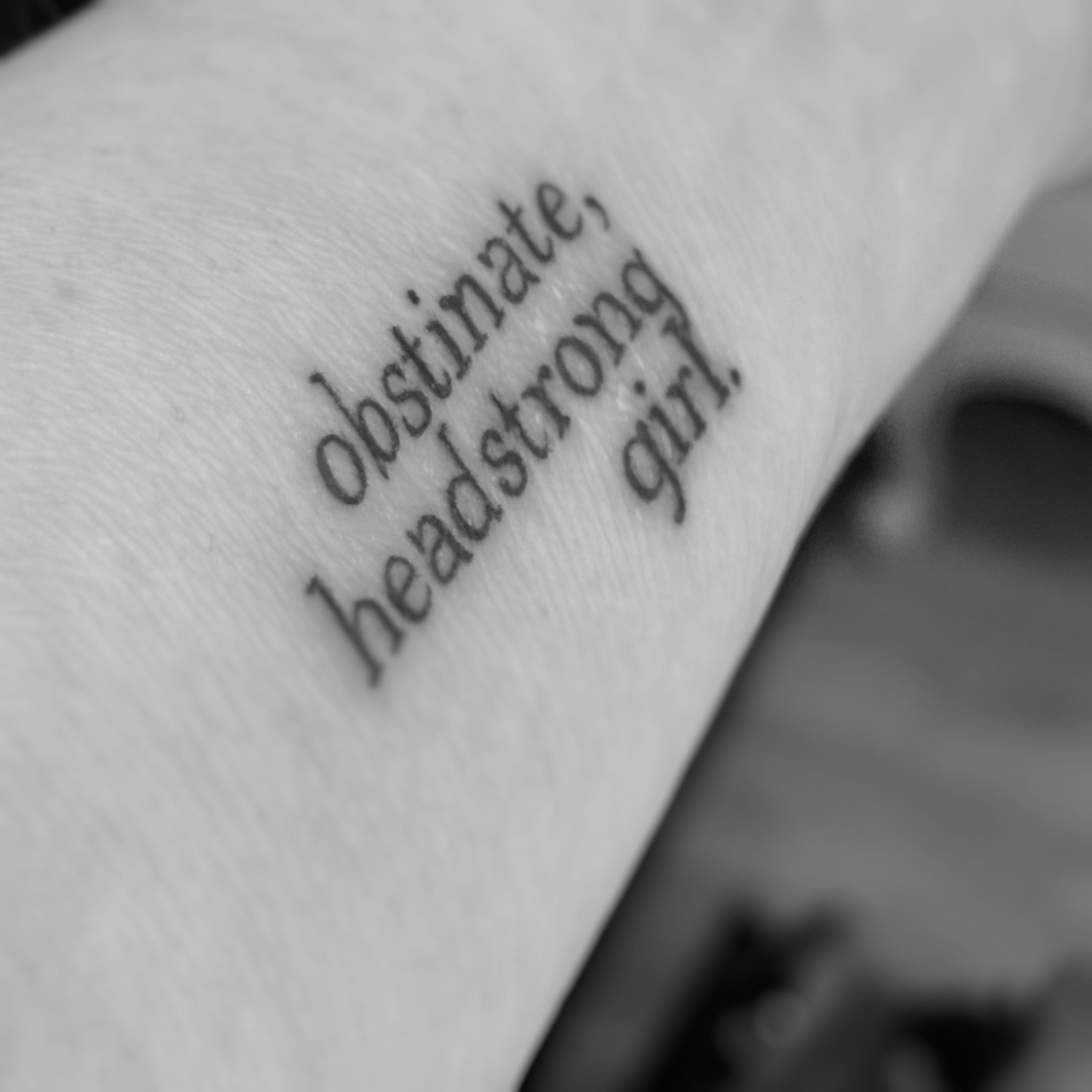
Love what you love, don’t let anyone yuck your yum, and smash all the figurines in your way.
You’ll survive.
Everything,
L
If you are a white woman who has ever been offended by the idea that white women are the men of women, here is an opportunity to understand a bit of what we’ve inherited. Not as an excuse, but just so that there’s an understanding to help us get past the idea that we cannot ever be wrong about anything, which is the tightening corset that keeps us contributing to our own oppression and that of others. Something to ponder.
Don’t get me wrong; I believe deeply in the left side of things, and I cannot see that ever changing. But there is a segment of us that care more about performing our superiority than about actually fighting for the people stuck in the lower tiers of the cake, and I have zero patience for that shit.
Great piece. One of your footnotes made me think of something I saw recently that put succinctly a thought I'd had for years: To people with privilege, equality feels like oppression.
I love your hot takes and reflection on the cultural / social norms of then and now. ALSO - write that regancy horror!